
Make a Comment, Add a Thought...

Social Media, NPOs and Fundraising: Here to Stay!
December 19, 2012
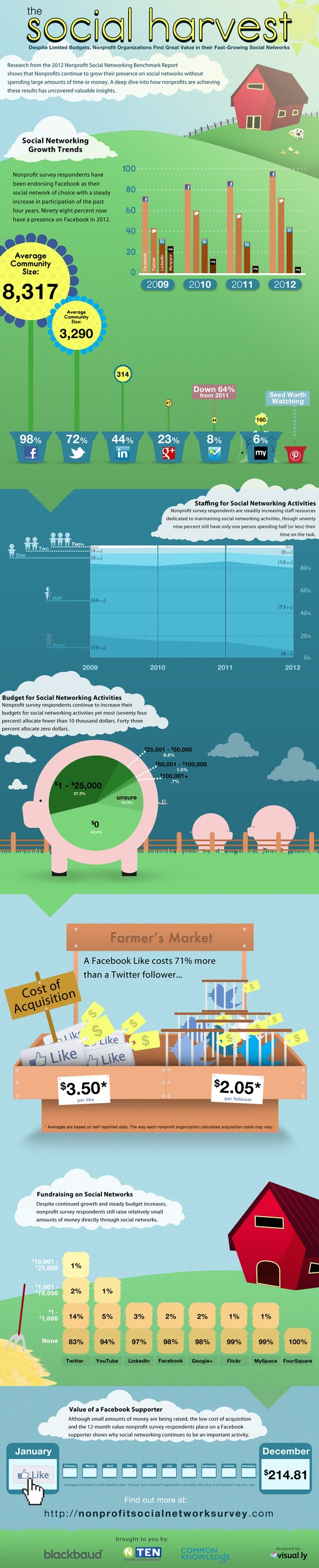 |
Social media use by nonprofit organizations continues to grow and has become a fundamental fundraising and social engagement tool. In fact, nonprofit use of social media has grown significantly in the past year, with average Facebook communities growing by 30% and Twitter communities up 81%. Like it or not, social media may be here to stay!
Three major reports were recently released on nonprofit marketing and fundraising:
2012 Online Marketing Nonprofit Benchmark Index Study (Convio)
2012eNonprofit Benchmark Study (M+R and NTEN)
2012 Nonprofit Social Networking Benchmark Report (NTEN, Common Knowledge and Blackbaud)
We’ve distilled the salient information here:
Community Size
For every 1,000 members of a nonprofit’s email list, the average organization had 103 Facebook fans, 29 Twitter followers and 12 mobile subscribers. While nonprofit communities on Facebook and Twitter show significant increases, nonprofit community size on LinkedIn has dropped to the lowest it has ever been.
Engagement and Fundraising
Forty-six percent of respondents in the Blackbaud report indicate they are using Facebook for fundraising. The most common technique is asking for an individual gift, followed by invitation to/buzz about a fundraising event.
Facebook ads to enhance fundraising are used by 24% of respondents, typically to build awareness of the organization and its cause.
Nonprofits average 2.5 actions per 1,000 Facebook users (“action rate” is calculated as the number of daily “likes” and comments on a page’s content divided by the total number of Facebook users).
Budget and Staffing
Social media use isn’t costly, yet can bring big returns for nonprofits. Forty-three percent of respondents budget NOTHING for their social networking activities; however, the average value of a Facebook “like” is $214.81 (in cash contributions) over 12 months following acquisition. Nonprofits spend an average of $3.50 to acquire a Facebook fan and $2.05 per new Twitter follower.
The majority of respondents (73%) allocate a .5 FTE employee to manage social networking activities.
According to Blackbaud, the top three factors for fundraising success in use of social media are strategy, prioritization, and dedicated staff.
We'll share more tips and strategies on how to best use social media in a future post.
Three major reports were recently released on nonprofit marketing and fundraising:
2012 Online Marketing Nonprofit Benchmark Index Study (Convio)
2012eNonprofit Benchmark Study (M+R and NTEN)
2012 Nonprofit Social Networking Benchmark Report (NTEN, Common Knowledge and Blackbaud)
We’ve distilled the salient information here:
Community Size
For every 1,000 members of a nonprofit’s email list, the average organization had 103 Facebook fans, 29 Twitter followers and 12 mobile subscribers. While nonprofit communities on Facebook and Twitter show significant increases, nonprofit community size on LinkedIn has dropped to the lowest it has ever been.
Engagement and Fundraising
Forty-six percent of respondents in the Blackbaud report indicate they are using Facebook for fundraising. The most common technique is asking for an individual gift, followed by invitation to/buzz about a fundraising event.
Facebook ads to enhance fundraising are used by 24% of respondents, typically to build awareness of the organization and its cause.
Nonprofits average 2.5 actions per 1,000 Facebook users (“action rate” is calculated as the number of daily “likes” and comments on a page’s content divided by the total number of Facebook users).
Budget and Staffing
Social media use isn’t costly, yet can bring big returns for nonprofits. Forty-three percent of respondents budget NOTHING for their social networking activities; however, the average value of a Facebook “like” is $214.81 (in cash contributions) over 12 months following acquisition. Nonprofits spend an average of $3.50 to acquire a Facebook fan and $2.05 per new Twitter follower.
The majority of respondents (73%) allocate a .5 FTE employee to manage social networking activities.
According to Blackbaud, the top three factors for fundraising success in use of social media are strategy, prioritization, and dedicated staff.
We'll share more tips and strategies on how to best use social media in a future post.
No Comments
|
Add a Comment >>
Nap Anyone?
October 30, 2012
Children get to nap, sometimes twice a day. Even kindergartners get to “rest” during their school day. Unfortunately, American society frowns on adults taking naps. Yet research suggests that naps are highly beneficial…especially in the workplace.
A Stanford University study shows that 20% of us suffer from sleepiness. Earlier sleep studies suggest that a 10-minute nap is helpful now and then, while current research indicates that a 30-40 minute nap is even more beneficial because it allows time for the napper to enter into a state of “repair.”
The sleep cycle consists of three stages - light sleep, deep sleep (when the body begins to repair itself) and Rapid Eye Movement (REM). A half hour+ nap allows us to reach deep sleep, regaining lost sleep from the previous night.
Interrupting, or waking in the middle of a sleep stage may be counter-productive and create a sense of grogginess and disorientation. The key is to know our sleep cycles and wake at the completion of a sleep stage.
That mid-afternoon lull and sluggishness is not just the result of the big meal we had at lunch (although that may play a factor). We have a natural drowsiness that occurs approximately 8 hours after we wake. Some companies have responded to this fact in an effort to increase productivity: Google and Nike have designated nap areas for their employees, and encourage mid-shift napping. Continental Airlines pilots take turns napping, especially during longer flights. The benefits? Reduced stress, increased learning capacity and patience, better reaction time and better health.
So, let’s take a nap!
No Comments
|
Add a Comment >>
A lost Art?
September 17, 2012
A Lost Art?
I recently ran across an organization that gives children cameras to photo journal their days. The intent is to capture culture/community, and get a glimpse of day-to-day societal concerns through ‘the child lens.’ The photos alone speak to need, and the children’s approach provides the ultimate perspective: curious, unknowing, without prejudice.
If only we could do that in our work…….
Think about being able to understand our clients – to know their needs, their priorities, their challenges – based not on service-provider assumptions, but rather from walking with them, daily, block by block, and seeing the world they see. Surely we would be more effective in our efforts on their behalf.
The same is true in considering our co-workers and colleagues. A genuine glimpse into how they see the world can completely circumvent time wasted on misunderstandings or questioning intent. How efficient (and pleasant) our days could be!
We use many tools to increase our understanding of those around us. Surveys, focus groups, applications and interviews provide limited information. To increase our impact and meaningfully engage with others, we need to gather the information – through observation, through empathy, through openness – that will help us to truly understand.
There are ways for others to share their “journal” with us. In so doing, they allow us to be more effective and efficient in what we do. Taking the time for conversation and observation, hearing another’s story and listening for true understanding, always reveal the ways we can truly be of help. This process of discovery is both interesting and worthwhile, and the payoff is priceless.
I recently ran across an organization that gives children cameras to photo journal their days. The intent is to capture culture/community, and get a glimpse of day-to-day societal concerns through ‘the child lens.’ The photos alone speak to need, and the children’s approach provides the ultimate perspective: curious, unknowing, without prejudice.
If only we could do that in our work…….
Think about being able to understand our clients – to know their needs, their priorities, their challenges – based not on service-provider assumptions, but rather from walking with them, daily, block by block, and seeing the world they see. Surely we would be more effective in our efforts on their behalf.
The same is true in considering our co-workers and colleagues. A genuine glimpse into how they see the world can completely circumvent time wasted on misunderstandings or questioning intent. How efficient (and pleasant) our days could be!
We use many tools to increase our understanding of those around us. Surveys, focus groups, applications and interviews provide limited information. To increase our impact and meaningfully engage with others, we need to gather the information – through observation, through empathy, through openness – that will help us to truly understand.
There are ways for others to share their “journal” with us. In so doing, they allow us to be more effective and efficient in what we do. Taking the time for conversation and observation, hearing another’s story and listening for true understanding, always reveal the ways we can truly be of help. This process of discovery is both interesting and worthwhile, and the payoff is priceless.
No Comments
|
Add a Comment >>
What Are We Working For?
September 6, 2012
I came across this quote and thought it might be inspiring to the workplaces served through Third Sector Innovations:
You are not here merely to make a living. You are here in order to enable the world to live more amply, with greater vision, with a finer spirit of hope and achievement. You are here to enrich the world, and you impoverish yourself if you forget the errand." -Woodrow Wilson
You are not here merely to make a living. You are here in order to enable the world to live more amply, with greater vision, with a finer spirit of hope and achievement. You are here to enrich the world, and you impoverish yourself if you forget the errand." -Woodrow Wilson
No Comments
|
Add a Comment >>
What Got You Here Won't Get You There
August 24, 2012
You’ve heard the story, or maybe it’s yours…
You’re hard working, intelligent. You meet all your goals and consistently exceed expectations. Your supervisor raves about the quality of your work and that your performance rises above your peers. Yet, year after year, you are not recognized and do not get promoted.
What Got You Here Won’t Get You There by Executive Coach Marshall Goldsmith discusses reasons why professionals don’t achieve greater success, and explains that this most often occurs because common workplace habits need to be broken.
In a recent Third Sector Innovations’ training, I heard a quote, “CEOs are hired for their intellect and business expertise, and fired for their lack of emotional intelligence” (Goleman, 2006, Emotional Intelligence). Goldsmith points out that the skills that got you to a given level of success – intellect and business expertise – may not be enough, and that certain behaviors – emotional intelligence – may hold you back from greater success. He argues that bad habits often are not based in personality or intellect: “What we’re dealing with here are challenges in interpersonal behavior, often leadership behavior.” He says that these “transactional flaws” are typically unconscious and manifest when working with – and, ultimately, against – others.
There is comfort in the fact that these “flaws” are not hard wired, and can be changed with the right motivation. Goldsmith talks about ways coaching can uncover the behaviors that hold you back…but that’s the easy part. The hard part is admitting the habit, realizing the habit is detrimental to career/life growth, and then finding the motivation to change; only then can the work begin and change/growth occur.
What Got You Here Won’t Get You There is a great guide to understanding what behaviors may be interfering with your success. It can help you to better recognize yourself and decide on next steps to moving forward in your career and otherwise finding your greatness!
You’re hard working, intelligent. You meet all your goals and consistently exceed expectations. Your supervisor raves about the quality of your work and that your performance rises above your peers. Yet, year after year, you are not recognized and do not get promoted.
What Got You Here Won’t Get You There by Executive Coach Marshall Goldsmith discusses reasons why professionals don’t achieve greater success, and explains that this most often occurs because common workplace habits need to be broken.
In a recent Third Sector Innovations’ training, I heard a quote, “CEOs are hired for their intellect and business expertise, and fired for their lack of emotional intelligence” (Goleman, 2006, Emotional Intelligence). Goldsmith points out that the skills that got you to a given level of success – intellect and business expertise – may not be enough, and that certain behaviors – emotional intelligence – may hold you back from greater success. He argues that bad habits often are not based in personality or intellect: “What we’re dealing with here are challenges in interpersonal behavior, often leadership behavior.” He says that these “transactional flaws” are typically unconscious and manifest when working with – and, ultimately, against – others.
There is comfort in the fact that these “flaws” are not hard wired, and can be changed with the right motivation. Goldsmith talks about ways coaching can uncover the behaviors that hold you back…but that’s the easy part. The hard part is admitting the habit, realizing the habit is detrimental to career/life growth, and then finding the motivation to change; only then can the work begin and change/growth occur.
What Got You Here Won’t Get You There is a great guide to understanding what behaviors may be interfering with your success. It can help you to better recognize yourself and decide on next steps to moving forward in your career and otherwise finding your greatness!
A Whole New Mind
August 2, 2012
You’ve probably heard people described as either “left brain” or “right brain” thinkers. A person who is “left brained” is often said to be more logical, analytical and objective. Think attorneys, computer programmers, accountants. A person who is “right brained” is inclined to being intuitive, thoughtful, subjective; artists and musicians fall into this category.
This concept of left/right brain thinking developed from the late-1960s research of American psycho-biologist Roger W. Sperry, who actually won the Nobel Prize (1981) for this work. He discovered that the human brain has two very different ways of thinking. The left brain is verbal and processes information in an analytical and sequential way, looking first at the pieces then putting them together to get the whole. The other (the right brain) is visual and processes information in an intuitive and simultaneous way, looking first at the whole picture then the details.
Traditionally, our information driven society has placed more value on “left brainers.” But Daniel H. Pink’s book, A Whole New Mind: Why Right Brainers Will Rule the World, argues that America is moving into a “conceptual age” and that right-brain qualities – inventiveness, empathy, meaning – will be dominant attributes that have a better chance of overcoming the obstacles of this new era, while left-brain activities can be relegated to computers and outsourced to workers overseas.
Pink writes, ““…the defining skills of the previous era – the ‘left brain’ capabilities that powered the Information age – are necessary but no longer sufficient. And the capabilities we once disdained or thought frivolous – the ‘right-brain’ qualities of inventiveness, empathy, joyfulness, and meaning – increasingly will determine who flourishes and who flounders. For individuals, families, and organizations, professional success and personal fulfillment now require a whole new mind.”
What about you: Are you a left-brainer or right brainer? Has success in your organization traditionally been due to high left-brain function…and can you make the shift to the “Conceptual Age” and its call for right brain competencies???
posted by Suzy
This concept of left/right brain thinking developed from the late-1960s research of American psycho-biologist Roger W. Sperry, who actually won the Nobel Prize (1981) for this work. He discovered that the human brain has two very different ways of thinking. The left brain is verbal and processes information in an analytical and sequential way, looking first at the pieces then putting them together to get the whole. The other (the right brain) is visual and processes information in an intuitive and simultaneous way, looking first at the whole picture then the details.
Traditionally, our information driven society has placed more value on “left brainers.” But Daniel H. Pink’s book, A Whole New Mind: Why Right Brainers Will Rule the World, argues that America is moving into a “conceptual age” and that right-brain qualities – inventiveness, empathy, meaning – will be dominant attributes that have a better chance of overcoming the obstacles of this new era, while left-brain activities can be relegated to computers and outsourced to workers overseas.
Pink writes, ““…the defining skills of the previous era – the ‘left brain’ capabilities that powered the Information age – are necessary but no longer sufficient. And the capabilities we once disdained or thought frivolous – the ‘right-brain’ qualities of inventiveness, empathy, joyfulness, and meaning – increasingly will determine who flourishes and who flounders. For individuals, families, and organizations, professional success and personal fulfillment now require a whole new mind.”
What about you: Are you a left-brainer or right brainer? Has success in your organization traditionally been due to high left-brain function…and can you make the shift to the “Conceptual Age” and its call for right brain competencies???
posted by Suzy
No Comments
|
Add a Comment >>
Strong Leaders / Strong Stories
Strong leaders have strong stories, and a solid sense of "self" as a leader. But too often, even strong women view themselves or are perceived as being very good at "getting things done," but not as valuable strategic resources. What can you do to change this? Find Out More Here
Grand Junction, CO | Littleton, CO
970-314-3970 | Email TSI